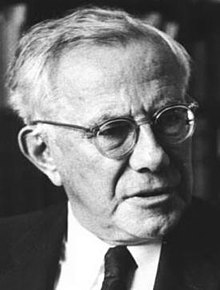
The God of theological theism is a being beside others and as such a part of the whole of reality. He certainly is considered its most important part, but as a part and therefore as subjected to the structure of the whole. He is supposed to be beyond the ontological elements and categories which constitute reality. But every statement subjects him to them. He is seen as a self which has a world, as an ego which is related to a thou, as a cause which is separated from its effect, as having a definite space and an endless time. He is a being, not being-itself. As such he is bound to the subject-object structure of reality, he is an object for us as subjects. At the same time we are objects for him as a subject. And this is decisive for the necessity of transcending theological theism. For God as a subject makes me into an object which is nothing more than an object. He deprives me of my subjectivity because he is all-powerful and all-knowing. I revolt and try to make him into an object, but the revolt fails and becomes desperate. God appears as the invincible tyrant, the being in contrast with whom all other beings are without freedom and subjectivity. He is equated with the recent tyrants who with the help of terror try to transform everything into a mere object, a thing among things, a cog in the machine they control. He becomes the model of everything against which Existentialism revolted. This is the God Nietzsche said had to be killed because nobody can tolerate being made into a mere object of absolute knowledge and absolute control. This is the deepest root of atheism. It is an atheism which is justified as the reaction against theological theism and its disturbing implications. It is also the deepest root of the Existentialist despair and the widespread anxiety of meaninglessness in our period. (The Courage to Be, 184-186)Obviously, Tillich searches for such an absolute rootedness of being that would become the ground of self-affirmation (the essence of the courage to be) and put an end to the anxiety of death and meaninglessness. Undoubtedly, such a quest implies faith in the relation between individual experience (self) and the ultimate ground of being (reality). Eastern philosophy abounds in approaches towards this problem in both Advaitin and Buddhist philosophies (one asserting the Self as the Underlying Reality and the other asserting the non-reality of the Self). However, can Tillich's quest be complete without properly addressing the epistemic issues of this existential quest for absolute reality in relation to itself? In Epistemics of Divine Reality, the chief argument has been to demonstrate that the disagreement between empirical and rational theologies has been in essence a problem of epistemological approach. Rational theologies cannot accept God as a being (The Upanisads refer to God as the non-dual in order to avoid the notion of monotheism). Empirical theologies, on the other hand, cannot accept the existence of Being apart from beings; and so, it makes no empirical sense to talk of being-itself. The paradoxical situation is that both the categories of reason and the entities of experience cannot be denied. Rational Fideism maintains that the answer is only found through faith in the self-revelation of God and in rational faith reason and experience find meaningfulness. The God who transcends also dwells in us; the God who is one is also Triune; the God who is a necessary being is also affected and moved by human actions; the God who is immutable is also the God who takes the form of man; the God who is infinite is also the God who enters the finite world of man.
But, knowing God is not self-realization. God as self-realization is the argument of rational theology that cannot accept the creation of something out of nothing and posits being as one; and so, the universe as non-dual and eternal or beyond space-time. In non-dualism, rational theology reaches its ultimate conclusion: individual consciousness, for it, must affirm cosmic consciousness (aham brahmasmi). In rational fideism, as the view may be called, knowing God means to know Him as the Transcendent Spirit and yet as not distant from us, as the Source of all things and yet distinct from all things, as the transcendent one and yet the moral Governor of the universe, as immutable and yet active. God is certainly a Being as the "I AM THAT AM" whose identity and existence is not dependent on anything else. He IS. He is God. As such, it seems meaningless to talk of God as the Ground of Being of God (God Above God). That doesn't solve the problem. For one immediately can ask, "What is the Ground of Being of this 'Ground of Being of God'," and so on ad infinitum. If we can rationally accept the possibility of an ultimate reality, then there is no reason to not affirm that this First and the Last is God Himself as Who He is.
Comments
Post a Comment